Google Core Algorithm Update of May 2026
 Same Keyword, Different Google - The Dynamic SERP Personalization Theory
By: Schieler De'Land
The Google Core Algorithm Update of May 2026 may be dynamically sculpting the user journey inside the SERPs, marking one of the most unprecedented changes of all time for search engine optimization.
For years, SEO reporting has been built around a simple idea: a keyword has a ranking, and that ranking can be tracked. A business is position #1, position #2, position #3, or somewhere lower. Rank trackers, SEO reports, client conversations, and internal strategies have all been built around that basic assumption.
But what happens when Google no longer shows everyone the same search result page?
Over the last several days, we have been running an informal observational study across logged-in Google profiles to test how much the search results vary when different users search the same keyword. The early findings suggest something much bigger than normal ranking volatility may be happening.
Google may not only be changing the order of results. Google may be changing the entire search experience based on the person searching.
This is what I am calling the Dynamic SERP Personalization Theory.
Note: This is an ongoing observational study and will be updated as more data is collected. The findings below should be treated as directional, not final.
Same Keyword, Different Google - The Dynamic SERP Personalization Theory
By: Schieler De'Land
The Google Core Algorithm Update of May 2026 may be dynamically sculpting the user journey inside the SERPs, marking one of the most unprecedented changes of all time for search engine optimization.
For years, SEO reporting has been built around a simple idea: a keyword has a ranking, and that ranking can be tracked. A business is position #1, position #2, position #3, or somewhere lower. Rank trackers, SEO reports, client conversations, and internal strategies have all been built around that basic assumption.
But what happens when Google no longer shows everyone the same search result page?
Over the last several days, we have been running an informal observational study across logged-in Google profiles to test how much the search results vary when different users search the same keyword. The early findings suggest something much bigger than normal ranking volatility may be happening.
Google may not only be changing the order of results. Google may be changing the entire search experience based on the person searching.
This is what I am calling the Dynamic SERP Personalization Theory.
Note: This is an ongoing observational study and will be updated as more data is collected. The findings below should be treated as directional, not final.
1. What Is the Dynamic SERP Personalization Theory?
The Dynamic SERP Personalization Theory states that Google appears to be increasingly assembling different search result pages for different users searching the same keyword, potentially based on profile-level signals, search history, behavior patterns, device type, location signals, commercial intent, and Google’s prediction of what that specific user is most likely to engage with. In plain English, two people can search the exact same keyword, around the same time, and see materially different versions of Google. Not just different ranking orders. Different layouts. Different ad placements. Different map pack visibility. Different AI Overview presence. Different organic winners. Different directory results. Different review sites. Different forum results. Different image modules. Different search journeys. The keyword stays the same, but the SERP changes because the searcher changes. That is the core of the theory. For local SEO, this is a massive shift because most ranking tools are still built around the idea of tracking one controlled version of Google. That version may still have value, but it may not fully represent what real customers are seeing when they search while logged into their normal Google account, on their normal device, with years of behavioral data attached to their profile.2. Why This Matters for SEO and Rank Tracking
Traditional rank tracking is not useless. It still gives direction, historical movement, and a controlled baseline. The problem is that a controlled baseline may no longer represent the full reality of the SERP. A rank tracker may show a company ranking #1. The agency may see that company ranking #1. The client may search manually and not see it. A real customer may search and receive a completely different layout where the #1 organic result is pushed below paid ads, Local Service Ads, AI Overviews, map packs, Yelp, Reddit, image carousels, or other Google modules. That means “we rank #1” is becoming a less complete statement unless we also define which version of the SERP we are talking about. The better question may no longer be, “Where do we rank?” The better question may be, “How often are we visible across the different SERP experiences real customers are actually seeing?” That changes the conversation from ranking position to SERP surface coverage. In other words, businesses may need to care less about owning one static ranking and more about appearing across as many high-intent search surfaces as possible: organic, local pack, paid search, Local Service Ads, AI Overviews, review platforms, directories, forums, image results, video results, and comparison-style content.3. What the Observational Data Is Showing So Far
This study started after noticing that rank tracking logs and real-world manual searches were not lining up the way they previously had. What first looked like normal volatility started to look more structural after screenshots were collected from multiple logged-in Google profiles searching the same keywords. The current data is still observational. This is not being presented as a final scientific study. There are variables that need to be controlled more tightly over time, including exact user location, device type, browser state, account history, search timing, and whether the user is logged into Google. However, the early data is strong enough to justify deeper testing.| Study Area / Keyword Type | Sample Details | Early Observations | Why It Matters |
|---|---|---|---|
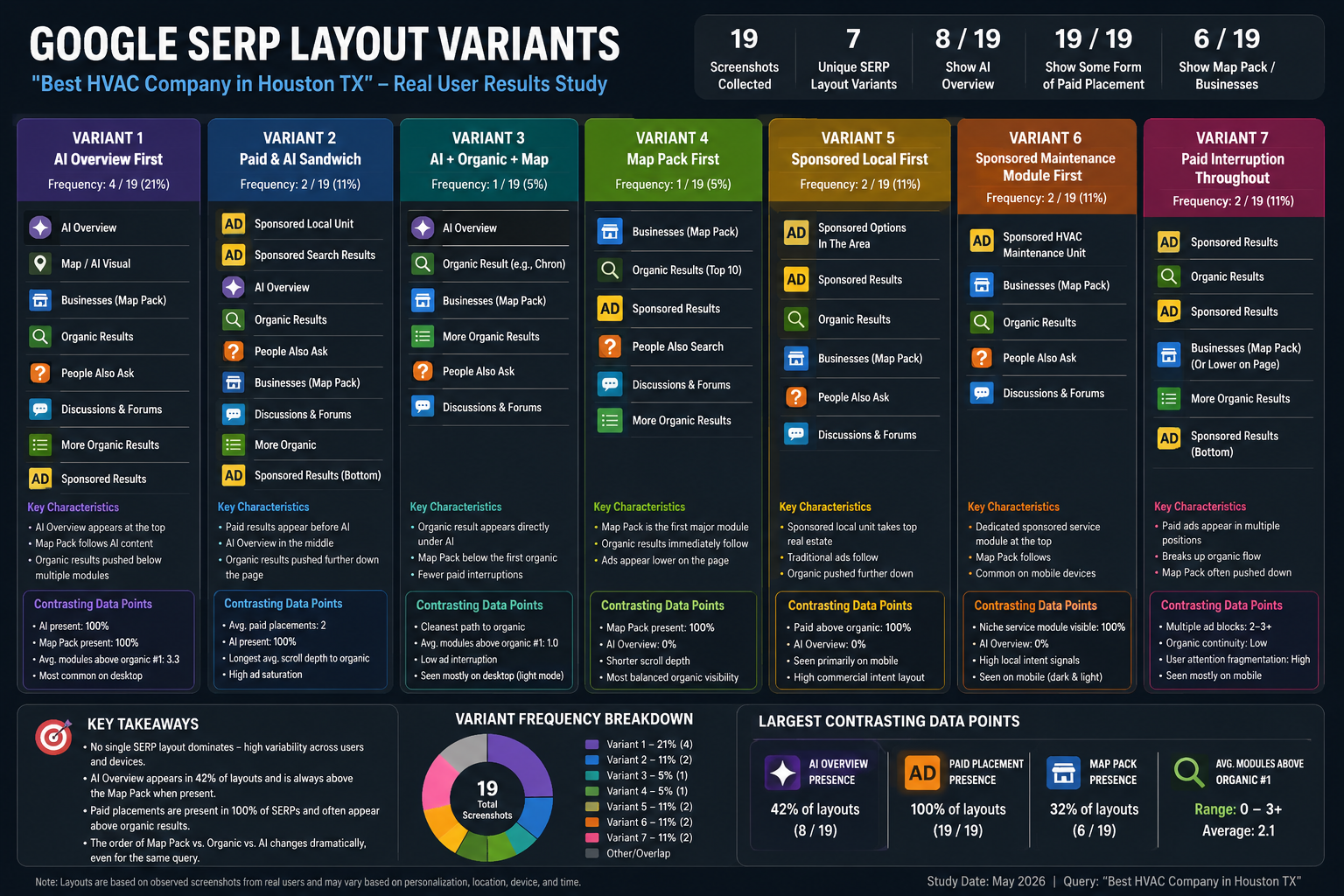
| Best HVAC Company in Houston TX | 19 screenshots collected in one layout study | 7 unique SERP layout variants observed; AI Overview appeared in several versions; paid appeared across all observed layouts; map/business results appeared inconsistently | Suggests the same keyword may trigger different SERP structures depending on user/search context |
| Best HVAC Company in Houston TX | Larger screenshot set reviewed separately | #1 organic result rotated between different entity types including local businesses, publishers, directories, and forums | Suggests volatility may not only be positional, but entity/category based |
| Carpet Cleaning Phoenix AZ | 10 logged-in profile searches | 0% exact full-SERP match rate; local pack appeared in about half of observed searches; organic visibility varied by entity | Suggests real users may see meaningfully different competitive landscapes for the same local keyword |
| Water Restoration Henderson NV | 10 logged-in profile searches | Local pack, sponsored units, organic results, directories, People Also Ask, and discussion-style results appeared inconsistently | Suggests SERP construction changes across restoration keywords as well |
| Multi-industry agency owner test | 22 agency owners searching various keywords from different verticals | Approximate 32% overlap rate in top 5 positions was observed; AI Overviews, map pack counts, image modules, and organic ordering varied | Suggests the pattern may not be isolated to one niche or one city |
| Internal team screenshot collection | 12-person team manually checking keywords | Different team members saw materially different SERPs for the same keyword | Supports the idea that real-world logged-in searches can differ from rank tracking outputs |
